
Salt Lake City City Directory Collections
The Salt Lake City directory collection is a set of editions, not one uninterrupted run. Verified holdings include Crofutt's Salt Lake City Directory for 1885–86, the Excelsior Address Book and Family Directory for the 1893 season, R.L. Polk volumes from the 1890s and 1902, a 1919 directory with wider valley coverage, and selected Polk years through 1989–90. The University of Utah Marriott collection exposes many page images and OCR. The Salt Lake City Public Library supplies microfilm and local-history context.
| Collection | Years | Where Held | Access |
|---|---|---|---|
| Crofutt's Salt Lake City Directory | 1885–86 | Utah collections and library research routes | Historical scan / reference |
| Excelsior Address Book and Family Directory | 1893 season | University and historical collections | Historical reference |
| R.L. Polk city directories | 1890s, 1902, selected years to 1989–90 | University of Utah digital collection | Free images and OCR where scanned |
| Reverse or criss-cross pages | Post-1924 method noted by Research Center | Library, digital volumes, research staff | Address-first search |
The source set does not establish a complete annual run, a single final printed year, or every gap. Cite the individual volume and page. A 1919 edition reaches Murray, Midvale, Sandy, Garfield, and suburbs, so its scope is broader than the city name alone. That valley context can explain why a Salt Lake City listing appears beside a nearby municipality.
The digitized University of Utah city directories page is the fastest way to test a year before arranging a library visit.
OCR speeds discovery, but the scan controls the spelling, abbreviation, and page context.
Use the Salt Lake City Library Shelf
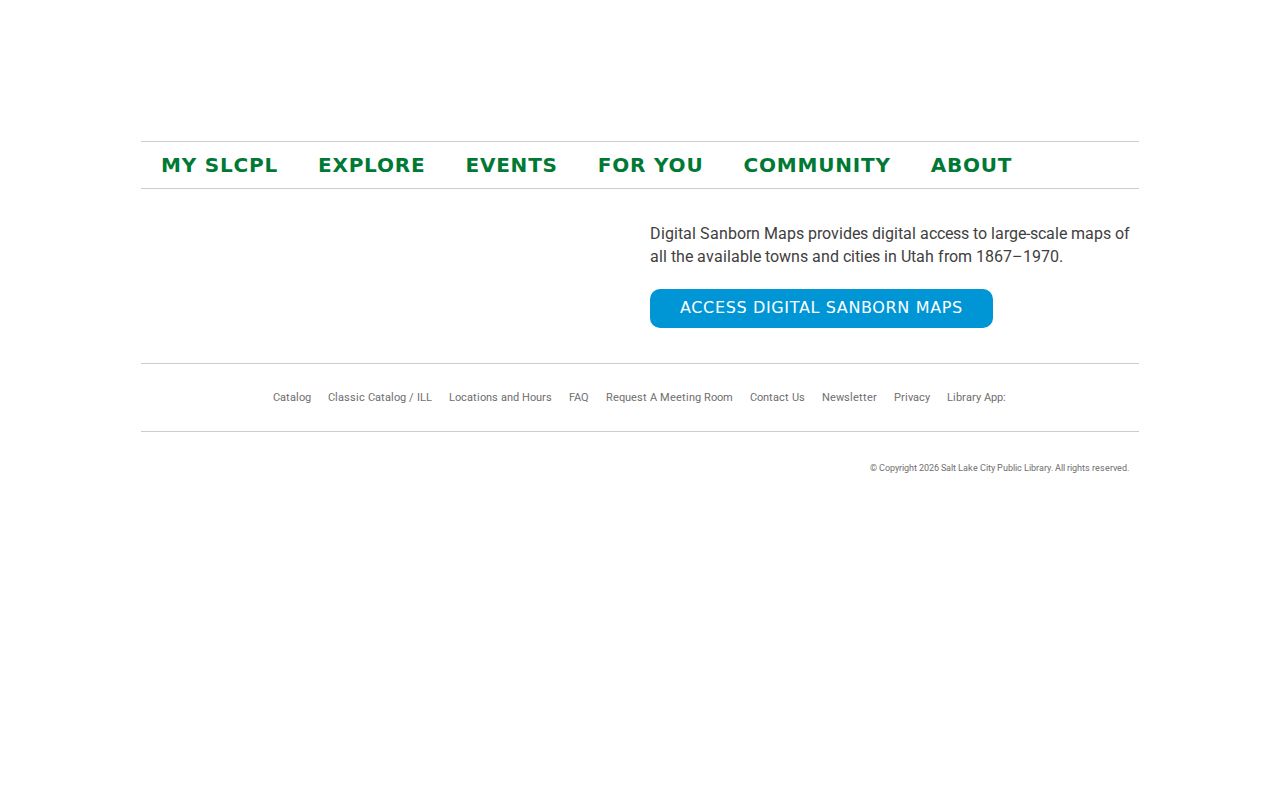
The Salt Lake City Public Library's Main Library keeps Periodicals Archives on Level 2 with historic newspaper and magazine microfilm, local clippings, and zines. Special Collections on Level 4 holds local-history books, photographs, maps, slides, scrapbooks, pamphlets, and Masonic Library records. Most material is for use in the library. Microfilm readers, scanners, catalog search, and the Periodicals Reference Request route help when a scan is not online.
The oldest newspaper microfilm identified in the research is Deseret News Weekly from June 15, 1850. HeritageQuest adds census and family-record collections. The library's Sanborn map route covers Utah towns and cities from 1867–1970, useful for checking whether an old address was a house, store, or larger site.
The Salt Lake City Library Archives page shows the local-history and microfilm access route.
Staff help and a reader can resolve a blurred scan or a name that OCR has split across lines.
Search Digital Salt Lake City Directories
The University of Utah Marriott digital collection is the main online home for scanned Utah city directories in the research set. A 1890 R.L. Polk item runs more than 800 pages and includes residents, streets, businesses, organizations, institutions, advertisements, alphabetical pages, and geographic sections. Search the OCR for a surname, then open the image. Page metadata identifies the publisher, date, collection, and source institution.
OCR is a finding aid, not a final transcription. It can confuse initials, street directions, “res,” and “bds.” Photograph or save the page link, read the surrounding entries, and check the volume's front matter for abbreviations and arrangement. The Utah Historical Society digital-collections route and Utah History Research Center staff provide additional catalog and research help when a needed edition is not scanned.
Use Salt Lake City Research Staff
The Utah History Research Center is a useful fallback when a Salt Lake City volume is not digitized or a name is hard to read. Its resources include digital photographs, cemetery and burial searches, historic markers, catalogs, and historic-property research. The center's own example describes using Polk directories, newspapers, and photographs to answer a “who lived in my house” question. Research requests can be directed to staff, although in-person service is limited during collection relocation.
County Archives adds naturalization, citizenship, proof-of-residence, deed, tax, and cemetery-adjacent sources. The State Archives naturalization guide says older files can contain name, country, age, occupation, marital status, immigration date, children, and witnesses. Salt Lake County Third District holdings reach about 1930 in the described series. These sources give a city directory entry family or migration context without changing what the entry itself says.
Reading a Salt Lake City City Directory Entry
A Salt Lake City city directory entry is compact, but several marks carry family-history value. In the 1890 OCR sample, Alice Hook is shown as “wid Richard” and boarding at an address. Louis Hook has a saddler occupation and a separate residence. Sidney K. Hooper has a real-estate business address and a distinct residence. Millie Reynolds is identified as a nurse with an office address and “res same.” These are source statements for that edition.
| Name | Name, honorific, initials, and sometimes a spouse or widow marker |
|---|---|
| Occupation | Trade or role, sometimes an associated business or employer |
| Address | Residence, business address, or boarding address |
| Household clue | “res same,” “bds,” and same-address entries need context |
| Owner or renter mark | Use only a symbol and key the volume actually explains |
- Criss-cross section
- The street or address-order half of a later directory, used to search for a listed occupant.
- Householder index
- An alphabetical finding aid for names or households, depending on the edition's arrangement.
- Abbreviation key
- The volume's explanation for short marks such as res for residence and bds for boarding.
Search the Reverse Pages by Address
The Utah History Research Center describes post-1924 Polk reverse pages, sometimes called the “pink pages,” as a practical way to ask who was listed at a Salt Lake address in a specific year. Start with the street and number, read the address section, then confirm the name in the alphabetical pages. For pre-1924 work, newspapers, preservation files, assessor material, Recorder records, and Archives sources may be needed.
Keep old spelling. “First South,” “South Temple,” “Fifth East,” and “Second West” are meaningful directions in the Salt Lake grid. If a number does not map today, compare the directory with a plat, tax serial, Sanborn map, or the city's official street-map history. A reverse entry suggests a listed occupant, not ownership or a current household.
Pair Directories With Newspapers and Maps
Utah Digital Newspapers searches full text and page images with date, paper, county, and article-type filters. Search a name with “death,” “obituary,” an old street, or a business, then read the image because OCR can miss an initial. An obituary may add relatives, a former address, cemetery, or community tie. It should be paired with a directory, vital record, cemetery search, or land record.
Sanborn fire-insurance maps add building context. The library route covers Utah cities from 1867–1970, and the Library of Congress has a Salt Lake City and Salt Lake County 1911–June 1949 volume. Maps can show footprint, use, materials, stories, lot lines, and street widths. They do not name residents, but they can explain a changed address or a business-residence pair.
Using Salt Lake City City Directories for Family History
Use a city directory as one dated layer in a household trail. Find the name, capture its exact spelling and address, then test the same person in the prior and next available editions. An address change may signal a move, a new household, a boarder leaving, a widow marker, or a business change. Pair the directory year with census and newspaper sources rather than treating a missing entry as proof of death or departure.
- Identify the exact person, street wording, and year range.
- Read the name page, then the reverse address pages where available.
- Compare the nearest earlier and later editions for moves, boarders, or household changes.
- Pair the listing with census or HeritageQuest, newspapers, tax cards, permits, or a deed record.
- Use Utah Digital Newspapers, County Archives, or City Cemetery for an event or death cross-check.
A person can disappear because the volume skips a year, the household moved, the name changed, the person was not listed, or the record is hard to read. The strongest conclusion comes from two independent sources with the same address, date, and identity markers. Keep the historical label “directory-listed resident” even when the entry feels like a household match.
A simple timeline can keep the editions in order: Crofutt 1885–86, Excelsior 1893, Polk 1890 and 1902, the wider valley volume in 1919, reverse-page methods after 1924, and selected Polk editions through 1989–90. This is a set of verified examples, not a claim that every year survives. Note the collection and page for each entry.
When the directory trail raises a property question, move to the modern assessor and Recorder rather than forcing the historic listing to answer it. When it raises a family question, add a newspaper, census, vital, cemetery, or naturalization source. The city directory remains the time-stamped address and occupation layer.